Flesch-Kincaid & Dwell Time: How Readability Boosts Your SEO
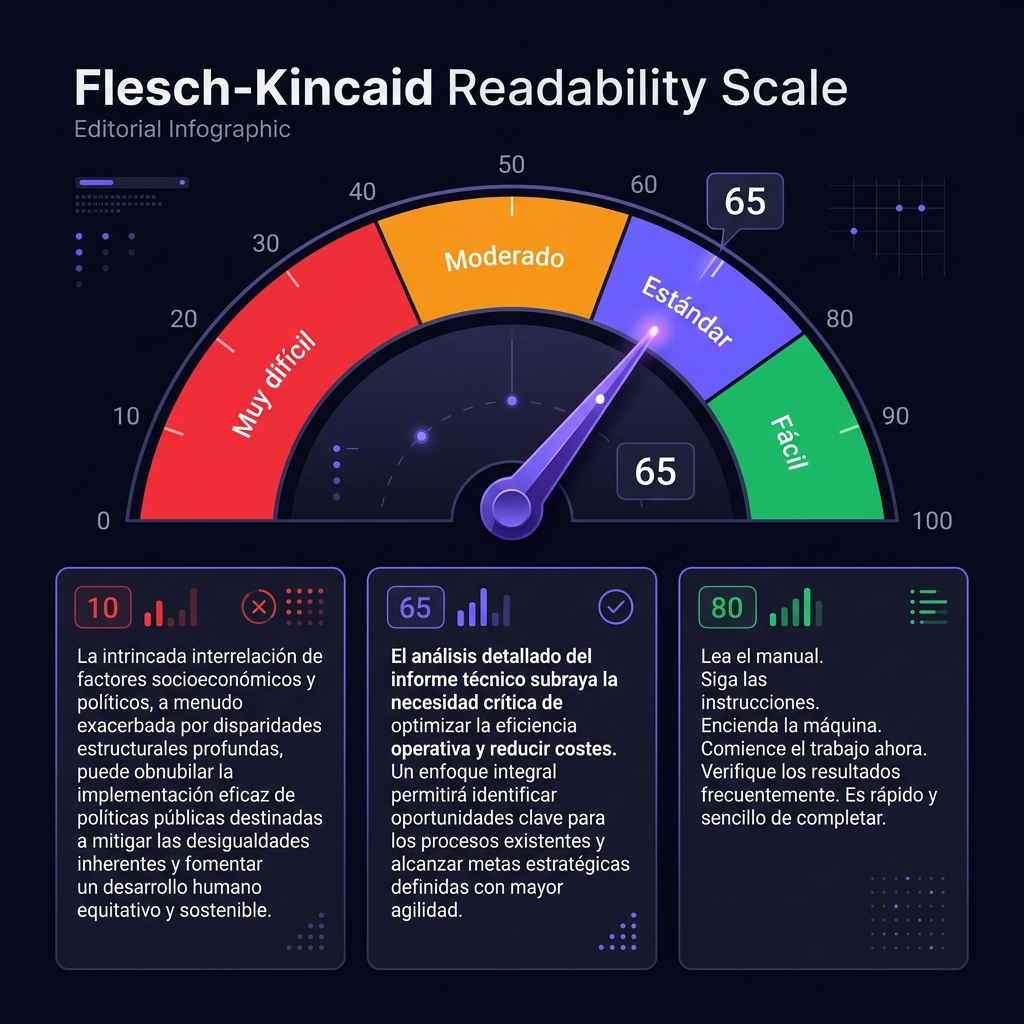
Readability measures how easy a piece of text is to understand. It's one of the most underrated factors in both SEO and content marketing — Google explicitly evaluates readability as part of its helpful content assessment, and readers who struggle with complex text bounce faster, directly impacting your AdSense RPM.
📊 The Flesch-Kincaid Formula
The most widely used readability formula in English is the Flesch Reading Ease score: 206.835 − (1.015 × Average Sentence Length) − (84.6 × Average Syllables per Word). It produces a score from 0 to 100, where higher scores mean easier reading. Most successful blog content scores between 60 and 70.
The Flesch Scale in Practice
The Two Levers of Readability
The Flesch formula is controlled by exactly two variables: sentence length and word complexity. Improving readability means adjusting one or both:
- Sentence length: Aim for an average of 15–20 words per sentence. Sentences over 30 words are almost always too long for digital content. Use a period more often than a comma.
- Word complexity: Prefer common, shorter words over technical jargon where possible. "Use" instead of "utilize," "show" instead of "demonstrate," "find" instead of "ascertain."
Readability and SEO: The Connection
Google's Helpful Content guidelines explicitly mention that content should be written for people, not search engines. While Google doesn't directly use the Flesch score as a ranking signal, the behavioral signals that correlate with readability — lower bounce rate, higher dwell time, more pages per session — are signals Google does measure and use.
A study by Backlinko analyzing 11.8 million Google search results found that content at approximately the 8th-grade reading level (corresponding to a Flesch score around 65–70) had 1.5× more organic backlinks than content at college-reading level, likely because more people can understand it and choose to share it.
How to Check Your Readability Score
Paste your text into WordCount Pro. The readability panel displays your Flesch Reading Ease score, average sentence length, and average word length in real time as you type. If your score is below 50, focus on breaking long sentences and replacing complex words. If it's above 80, you may be over-simplifying for your target audience.
Frequently Asked Questions
What Flesch score should I target for blog content?
Between 60 and 70 for general blog content. Technical niches (finance, medicine, law) can aim for 50–60. Content targeting a general consumer audience benefits from 65–75. The exact target depends on your reader's expected education level.
Does readability affect Google rankings directly?
Not directly as a scoring input, but indirectly through behavioral signals. High bounce rate from confused readers sends negative quality signals. Low dwell time on an article that was supposed to provide a detailed answer signals the content didn't satisfy the query.
Is the Flesch-Kincaid Grade Level the same as Flesch Reading Ease?
No. Flesch Reading Ease (0–100, higher = easier) and Flesch-Kincaid Grade Level (school grade equivalent, lower = easier) use different formulas that produce inversely related scores. A text scoring 65 on Reading Ease corresponds to roughly a 7th-8th grade reading level on the Kincaid scale.
Conclusion
Readability isn't about dumbing down your content — it's about respecting the reader's cognitive load. The sweet spot for English blog content is a Flesch Reading Ease score of 60–70: clear enough for broad audiences, substantive enough to signal expertise. Check your score with WordCount Pro before publishing, and prioritize shorter sentences and simpler words whenever clarity can be maintained.