Keyword Density: The Exact % Google Wants in 2026
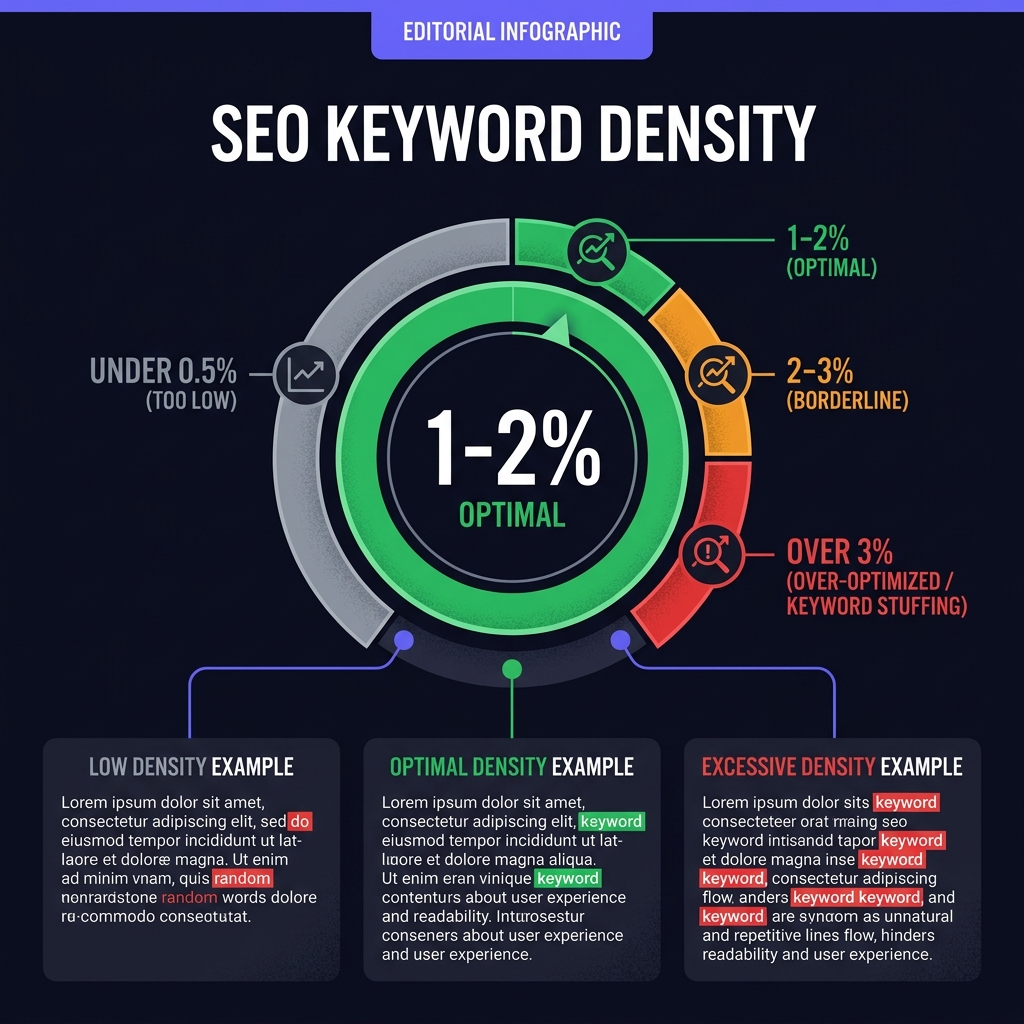
Keyword density measures what percentage of your total text is made up of your target keyword. For years, SEO meant stuffing content with keywords at 5%, 7%, even 10%. Google responded with Panda (2011) and the Helpful Content Update (2023), penalizing exactly that tactic. In 2026, density is no longer a ranking multiplier — it's a ceiling not to exceed.
📊 Industry Consensus 2026
SEMrush, Ahrefs, and Moz studies on Top 3 Google pages consistently show the primary keyword appears with a density of 0.5% to 1.5%. Above 2%, content starts being detected as keyword stuffing. Below 0.5%, Google may not associate the article with the target topic.
The Exact Calculation Formula
The math is simple: (number of keyword occurrences ÷ total word count) × 100. Real example: a 1,500-word article where "word counter" appears 12 times → (12 ÷ 1,500) × 100 = 0.8%. That's in the optimal range.
The practical challenge is counting this manually for long articles. The fastest approach is pasting your text into WordCount Pro and using the SEO Density Analysis panel, which automatically calculates keyword frequencies ordered by percentage.
How Google Detects Keyword Stuffing
The algorithm uses three combined signals to identify over-optimization:
- Abnormal proximity: If the same phrase appears multiple times in the same paragraph, Google's semantic model flags it as unnatural.
- Keyword-to-synonym ratio: Natural text uses variations. If 100% of mentions are the exact keyword with no synonyms, the artificiality signal is strong.
- Metadata density: Google also evaluates density in the
<title>, meta description, and H1. If all contain the exact keyword repeated, that's an additional negative signal.
Semantic Keywords: The Strategy That Replaced Density
Google uses Latent Semantic Indexing (LSI): it understands the topic from the complete semantic context of the article, not from keyword repetition. For the topic "word counter," semantically related terms include: text analysis, character count, words per minute, readability score, online tool. Including these naturally lets Google rank the article for all those variations without the author forcing repetition.
Optimal Keyword Density Rules 2026
- Primary keyword: 0.5% – 1.5% of total text
- LSI variations: No fixed target, appear naturally
- H1: Include the keyword exactly once
- H2 / H3: At least one with the keyword or a variation
- First paragraph: Keyword must appear within the first 100 words
- Read-aloud test: If it sounds repetitive, you have keyword stuffing
Density Targets by Content Type
How to Fix Over-Optimization
If your density calculation exceeds 2%, here are the techniques to reduce it without losing topical relevance:
- Pronouns and references: Use "the tool" instead of repeating the tool's name.
- Verified synonyms: Check Google Search Console's keyword panel to see which related terms you already rank for.
- Restructure paragraphs: Repetition often comes from short paragraphs covering the same concept; merging them reduces density without removing ideas.
- Clean up lists: Lists accumulate keywords easily — replace exact mentions with pronouns or references.
Frequently Asked Questions
What is the ideal keyword density percentage in 2026?
Between 0.5% and 1.5% for the primary keyword in 800–2,000 word articles. The most important factor is that the text reads naturally when read aloud.
Do keyword variations and synonyms count toward density?
Only if you define them as additional keywords. Density is calculated per exact term. However, using variations improves the semantic coverage that Google evaluates holistically.
Does Google penalize if I go below 0.5%?
Not directly, but it may not associate the article with your target topic, reducing ranking potential. The keyword must appear at minimum in the H1, first paragraph, and meta description.
How do I measure keyword density quickly?
Paste your text into WordCount Pro. The SEO Analysis panel shows all words ordered by frequency with their percentage of the total. You can also use Ctrl+F in your browser to count occurrences manually.
Conclusion
Correct keyword density isn't a precise number — it's a range of naturalness. In 2026, the goal isn't maximizing repetition but covering the full semantic field of the topic with the primary keyword as an anchor. Write for readers, verify the percentage with WordCount Pro, and adjust if you exceed 1.5%. Topical coverage quality always beats repetition volume.