How Many Words Does an Article Need to Rank on Google?
Reading time indicators — those "5 min read" labels at the top of articles — have become a standard UX element in content publishing. But behind that simple number lies a surprisingly nuanced calculation that depends on the type of content, the target audience, and the platform where you publish.
📊 The Research Behind 200–250 WPM
The most frequently cited study on adult reading speed (Brysbaert, 2019, published in Journal of Cognition) analyzed 190 studies with 18,573 participants and found a median silent reading speed of 238 words per minute for native English speakers reading digital text. Most reading time calculators use 200 WPM as a conservative estimate to account for comprehension pauses and re-reading.
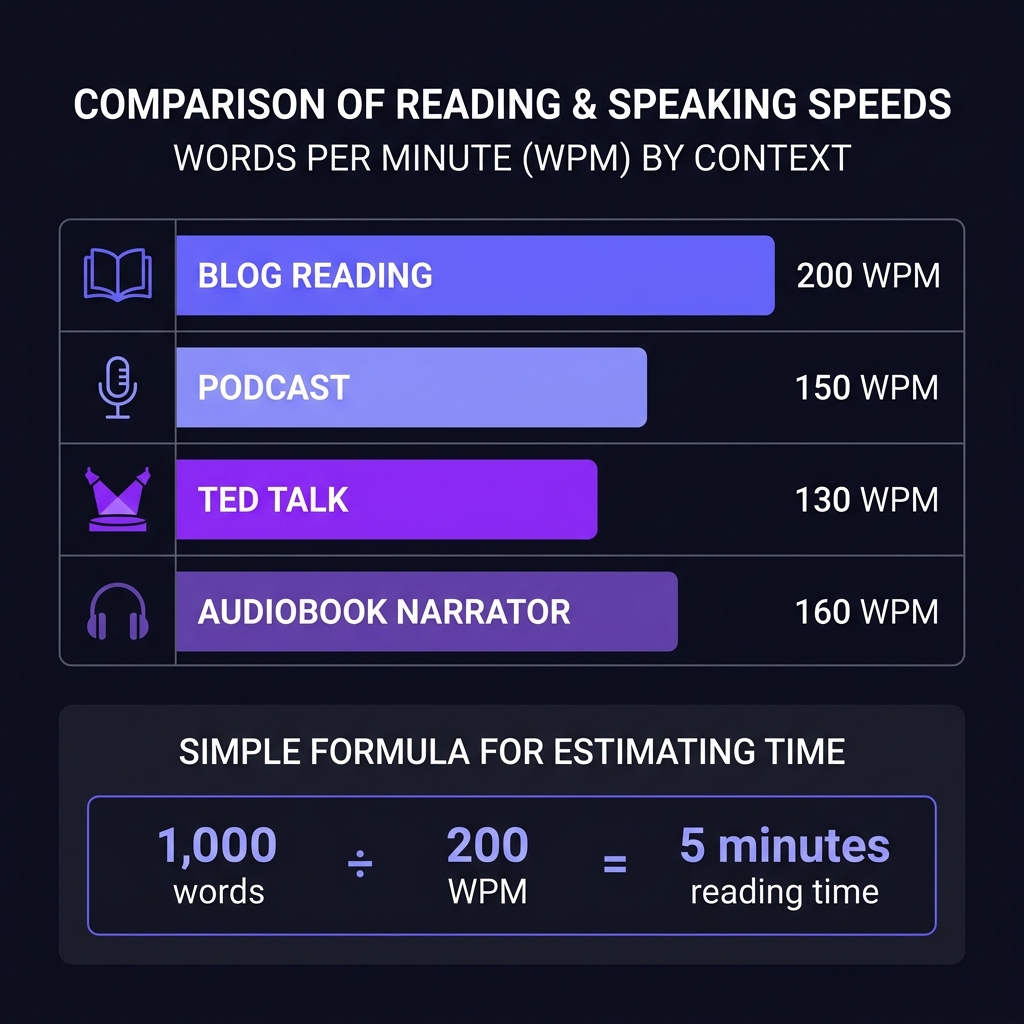
Reading Speed Varies Dramatically by Context
The Simple Formula
The standard reading time calculation used by Medium, Substack, and most editorial platforms is: Reading Time = Total Words ÷ 200 (result in minutes). For a 1,500-word article: 1,500 ÷ 200 = 7.5 minutes, displayed as "8 min read."
More sophisticated calculators add extra time for images: approximately 12 seconds for the first image, 11 seconds for the second, and so on down to 3 seconds per image after the tenth. This accounts for the fact that readers slow down when processing visual content.
Why Reading Time Matters for SEO and AdSense
Reading time is directly tied to Dwell Time — the metric Google uses to assess whether a page satisfied the user's search intent. A user who spends 7 minutes on your article sends a much stronger positive signal than one who bounces in 30 seconds. For AdSense, longer dwell time correlates with:
- More ad impressions per session (the page has time to serve multiple refresh cycles)
- Higher RPM classification (Google Ads Premium considers session quality when bidding)
- Better advertiser interest (longer sessions attract higher-paying retargeting ads)
How to Calculate Reading Time Before Publishing
Paste your article into WordCount Pro. The reading time estimate appears automatically in the stats panel, calculated at 200 WPM. If it's below 4 minutes for a standard blog post, consider whether there's additional value you could add — more examples, a FAQ section, or a comparison table.
Frequently Asked Questions
Is 200 WPM accurate for all readers?
No — 200 WPM is a conservative baseline for digital content. Faster readers average 250–300 WPM, while non-native speakers or readers of complex technical content may read at 100–150 WPM. The 200 WPM figure is a middle-ground estimate that works well as a universal display standard.
Does reading speed differ between print and screen?
Yes. Multiple studies show that on-screen reading is 20–30% slower than print reading due to screen glare, lower contrast, and scroll behavior. This is why web content benefits from shorter paragraphs, more white space, and clear subheadings — they compensate for the slower on-screen reading pace.
What's the optimal reading time for a blog post?
Medium's data shows posts with a 7-minute reading time (≈1,600 words) get the highest engagement before drop-off. For AdSense optimization, 5–8 minutes is the sweet spot — long enough to generate meaningful dwell time, short enough for readers to actually finish.
Conclusion
Reading time is more than a UX convenience feature — it's a proxy metric for content depth, user engagement, and ultimately ad revenue potential. Aim for a minimum of 5 minutes (≈1,000 words) for standard informational posts, and verify the estimate with WordCount Pro before hitting publish.