Academic Essay Word Count Guide: The 10% Tolerance Rule | WordCount Pro
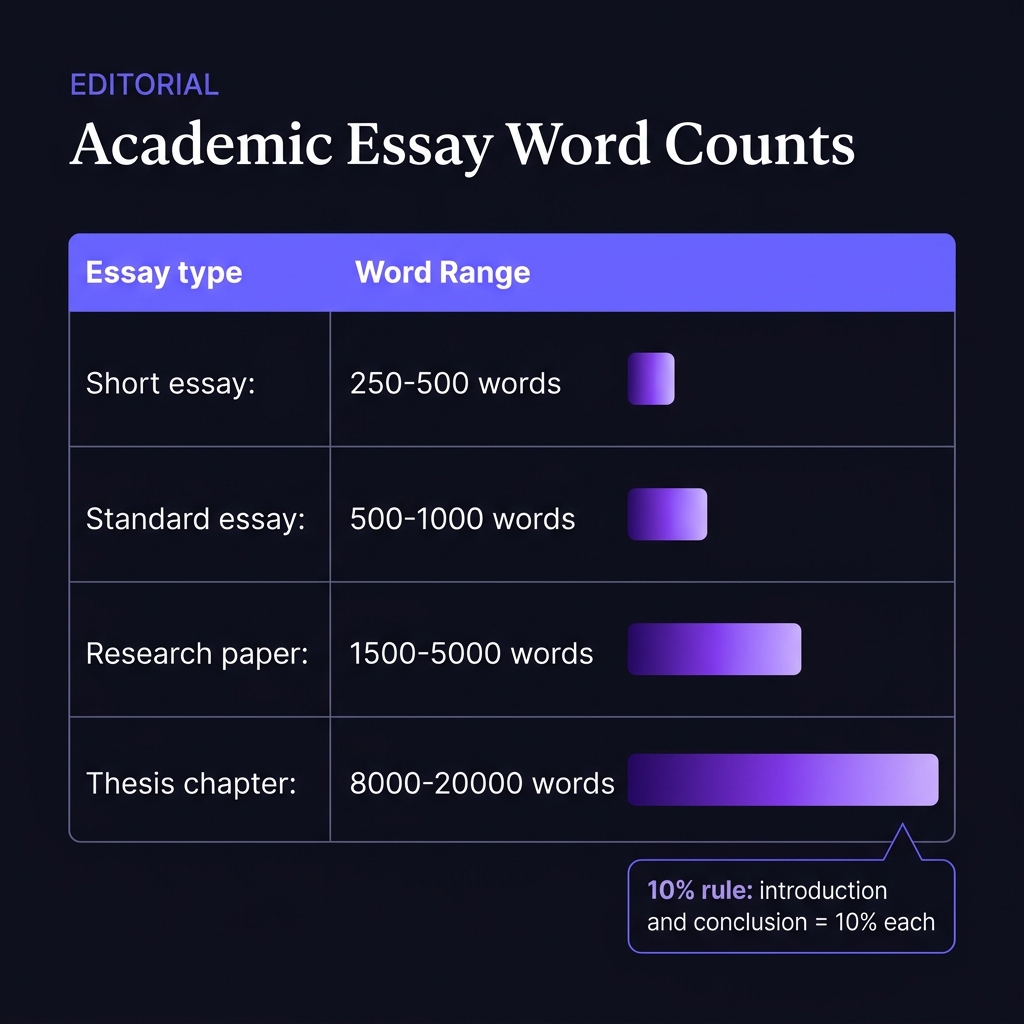
One of the most common mistakes in academic work isn't about content — it's about length. Submitting a 800-word essay when the prompt asks for 1,000, or exceeding the maximum by 40% because "there was more to say." Universities don't specify word counts arbitrarily: the ranges are calibrated to the level of argumentative development expected for each type of work.
📊 The 10% Rule
Most academic institutions apply a ±10% tolerance rule: a 1,000-word essay can be submitted with 900–1,100 words without penalty. Exceeding the upper margin can result in a direct grade deduction. Always verify whether your institution applies this rule explicitly or implicitly.
Word Count by Academic Work Type
Internal Distribution: How to Divide Your Words
Knowing the total word count isn't enough — you also need to distribute them correctly across essay sections. The standard academic structure follows this distribution:
- Introduction: 10% — Context, thesis statement or research question, paper structure
- Body: 80% — Argumentation, evidence, analysis, discussion
- Conclusion: 10% — Synthesis of findings, answer to thesis, implications
For a 1,000-word essay: ~100-word introduction, ~800-word body, ~100-word conclusion.
Do Footnotes, Bibliography, and Appendices Count?
The answer depends on the institution, but the general standard is:
- Bibliography and references: Almost never count toward the word limit.
- Footnotes: Depends on whether they're content notes or bibliographic notes. Many institutions exclude them.
- Tables and figures: Text within tables generally doesn't count.
- Appendices: Never count toward the main body word limit.
Pre-Submission Verification
The recommended process before submitting any academic work is to paste the full text into WordCount Pro and verify:
- Total word count and count per section
- Character count (for works with character limits)
- Number of paragraphs and sentences (to verify structure)
- Readability score (some works require a minimum complexity level)
Frequently Asked Questions
How many words is one page in standard academic format?
In standard US academic format (Times New Roman or Arial 12pt, double-spaced, standard 1-inch margins), one letter-size page is approximately 250 words. Single-spaced pages contain roughly 500 words each.
Is there a penalty for going below the minimum word count?
Yes, in most institutions. Falling below 90% of the required minimum typically results in a direct grade deduction, as it indicates the topic hasn't been developed with the expected depth. Some professors apply automatic penalties for each 10% the work falls below the minimum.
Do titles and headings count toward the word total?
It depends on the word processor and counter used. Microsoft Word and WordCount Pro both include headings in the total by default. If your institution excludes headings from the count, you'll need to count them separately and subtract from the total.
Conclusion
The word limit in academic work isn't an obstacle — it's an argument design tool. Knowing exactly how many words you have forces you to prioritize your strongest arguments, eliminate filler, and build a cleaner structure. Verify your count before submitting — always.