Characters vs. Words vs. AI Tokens: The Difference That Matters | WordCount Pro
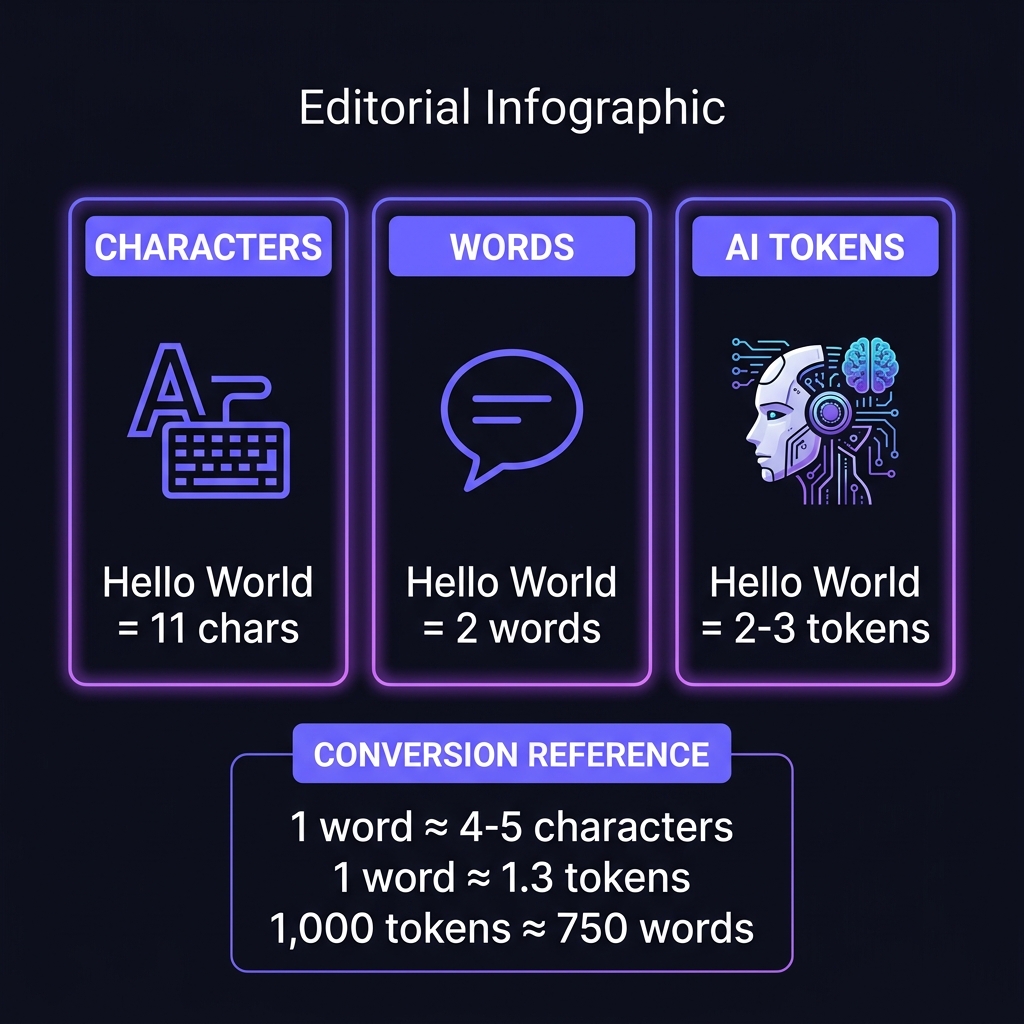
Words, characters, and tokens are three different ways to measure the same text. Each platform uses the one that works for its context: Twitter measures in characters, word processors in words, and AI models in tokens. Understanding the difference and knowing how to convert between them saves you formatting errors, unexpected truncations, and limit overruns in AI tools like ChatGPT or Claude.
📊 Quick Conversion Reference
- 1 word ≈ 4.7 characters (including spaces)
- 1 word ≈ 5.1 characters (excluding spaces)
- 1 word ≈ 1.3 tokens (in English, GPT models)
- 1,000 tokens ≈ 750 words in English
- 1,000 tokens ≈ 550–650 words in Spanish (longer tokens)
What Are Characters?
A character is any individual symbol in text: letters, numbers, spaces, punctuation, and emojis. The most important distinction is between characters with spaces (the standard for social media) and characters without spaces (used in some editorial contexts).
Not all characters weigh the same: basic Latin alphabet letters (A–Z, a–z) occupy 1 byte in UTF-8. Accented letters and special characters occupy 2 bytes. Emojis can occupy 4 bytes or more. This matters if you're working with APIs or systems that have byte limits rather than character limits.
What Are Words?
A word is any sequence of characters delimited by spaces or punctuation. Word counters have different criteria for edge cases:
- Hyphenated words: "well-being" counts as 1 or 2 words depending on the counter.
- Numbers: "2026" counts as 1 word.
- URLs: A full URL typically counts as 1 word in most counters.
- Contractions: "don't" generally counts as 1 word.
What Are AI Tokens?
Tokens are the processing unit of language models (LLMs). A token is not exactly a word or a character — it's a text fragment that the model recognizes as a unit. Most tokenizers split text into common morpheme substrings: "unhappiness" becomes the tokens ["un", "happ", "iness"] = 3 tokens for 1 word.
Factors that affect the number of tokens per word:
- Language: Non-English languages generally generate more tokens than English for the same word count, because longer or less-common words split into more fragments.
- Technical vocabulary: Uncommon or specialized words tend to tokenize into more fragments.
- Numbers and dates: Each digit can be a separate token.
Practical Conversion Table
When to Use Each Metric
- Social media: Always use characters (with spaces) — that's the metric all platforms use.
- Academic and editorial work: Words — the universal standard for publications.
- AI tools (ChatGPT, Claude, Gemini): Tokens — they determine both cost and context window limits.
- SMS / messaging: Characters, but with segmentation: SMS splits into 160-character segments (ASCII) or 70-character segments (Unicode/emoji).
Frequently Asked Questions
How many words is a 280-character tweet?
Approximately 47–56 words, assuming an average word length of 5 characters plus 1 space. The exact number depends on the specific vocabulary used in the tweet.
Why does ChatGPT consume more tokens for non-English languages?
Because GPT's tokenizer was trained primarily on English text. Words in other languages are generally longer and have lower frequency in the training corpus, so the tokenizer splits them into more fragments. The same content in French or Spanish costs approximately 30–40% more tokens than in English.
How do I know how many tokens my text has?
For GPT, use OpenAI's official tokenizer at platform.openai.com/tokenizer. For a quick estimate, divide the number of words by 0.75 for English, or by 0.55 for Spanish/French.
Conclusion
Words, characters, and tokens measure different dimensions of the same text. Knowing the conversion between them is a practical skill for anyone who works with text in digital environments — from the social media manager who can't exceed 280 characters, to the developer paying per API token. WordCount Pro displays all these metrics simultaneously in real time.